
Virtual Press Conference for media who serve Immigrant Community – May 27, 2020
https://covid19.lacounty.gov/wp-content/uploads/Ethnic-Briefing-for-May-27-2020.jpg
876
492
COUNTY OF LOS ANGELES
//covid19.lacounty.gov/wp-content/uploads/COVID19_Header_Logo.v2.png
COVID-19 briefing with LA County officials – May 27, 2020
https://covid19.lacounty.gov/wp-content/uploads/Briefing-for-May-27-2020.jpg
873
492
COUNTY OF LOS ANGELES
//covid19.lacounty.gov/wp-content/uploads/COVID19_Header_Logo.v2.png
COVID-19 briefing with LA County officials – May 27, 2020
COVID-19 briefing with LA County officials – May 27, 2020
COVID-19 briefing with LA County officials – May 22, 2020
https://covid19.lacounty.gov/wp-content/uploads/May-22-2020-briefing.jpg
873
493
COUNTY OF LOS ANGELES
//covid19.lacounty.gov/wp-content/uploads/COVID19_Header_Logo.v2.png
COVID-19 briefing with LA County officials – May 22, 2020
COVID-19 briefing with LA County officials – May 22, 2020
Emergency Cooling Centers Will Open Next Week Across Los Angeles County During Heat Wave
https://covid19.lacounty.gov/wp-content/uploads/updated-cover-logo-1024x512.png
1024
512
COUNTY OF LOS ANGELES
//covid19.lacounty.gov/wp-content/uploads/COVID19_Header_Logo.v2.png
Emergency Cooling Centers Will Open Next Week Across Los Angeles County During Heat Wave
Emergency Cooling Centers Will Open Next Week Across Los Angeles County During Heat Wave
Temperatures in parts of Los Angeles County are expected to rise into the 90s next week. As a result, several public facilities located throughout the County will open and serve as Emergency Cooling Centers on Tuesday, Wednesday, and Thursday of next week. These centers provide members of the public who lack air-conditioning at home with relief from the heat, free of charge. All centers will be open from 12:00 p.m. to 6:00 p.m, and will operate in compliance with physical distancing and other safety criteria from the current Health Officer Order.
A total of eight Emergency Cooling Centers will operate in areas based on heat forecasts and regions identified by the National Weather Service and the Los Angeles County Department of Public Health, respectively. More locations may be added and or extended based on weather conditions. To obtain a list of the County’s Emergency Cooling Centers or view a map of these sites, visit ready.lacounty.gov/heat or dial 2-1-1.
The County also reminds all members of the public to take the following extra precautions during hot weather:
- Avoid the sun – stay indoors from 10 a.m. to 3 p.m. when the burning rays are strongest.
- Drink plenty of fluids – 2 to 4 glasses of water every hour during times of extreme heat.
- Replace salt and minerals – sweating removes salt and minerals from your body, so replenish these nutrients with low sugar fruit juices or sports drinks during exercise or when working outside.
- Avoid alcohol.
- Pace yourself – reduce physical activity and avoid exercising outdoors during peak heat hours.
- Wear appropriate clothing – wear a wide-brimmed hat and light-colored lightweight, loose-fitting clothes when you are outdoors.
- Stay cool indoors during peak hours – set your air conditioner between 75° to 80°. If you don’t have air conditioning, take a cool shower twice a day and/or visit a County Emergency Cooling Center. Find a local emergency cooling center at ready.lacounty.gov/heat.
- Monitor those at high risk – check on elderly neighbors, family members and friends who do not have air conditioning. Infants and children up to 4 years old, people who overexert during work (e.g. construction workers) and people 65 years and older are at the highest risk of heat-related illnesses.
- Use sunscreen with a sun protection factor (SPF) of at least 15 if you need to be in the sun.
- Keep pets indoors – heat also affects your pets, so please keep them indoors. If they will be outside, make sure they have plenty of water and a shaded area to help them keep cool.
For more information on heat-related illnesses and prevention, please visit the Los Angeles County Department of Public Health’s website at publichealth.lacounty.gov.
Memorial day new openings beach bike paths indoor mall curbside car parades
https://covid19.lacounty.gov/wp-content/uploads/Santa-Monica_Pacific-Park_02-1024x674.jpg
1024
674
COUNTY OF LOS ANGELES
//covid19.lacounty.gov/wp-content/uploads/COVID19_Header_Logo.v2.png
Memorial day new openings beach bike paths indoor mall curbside car parades
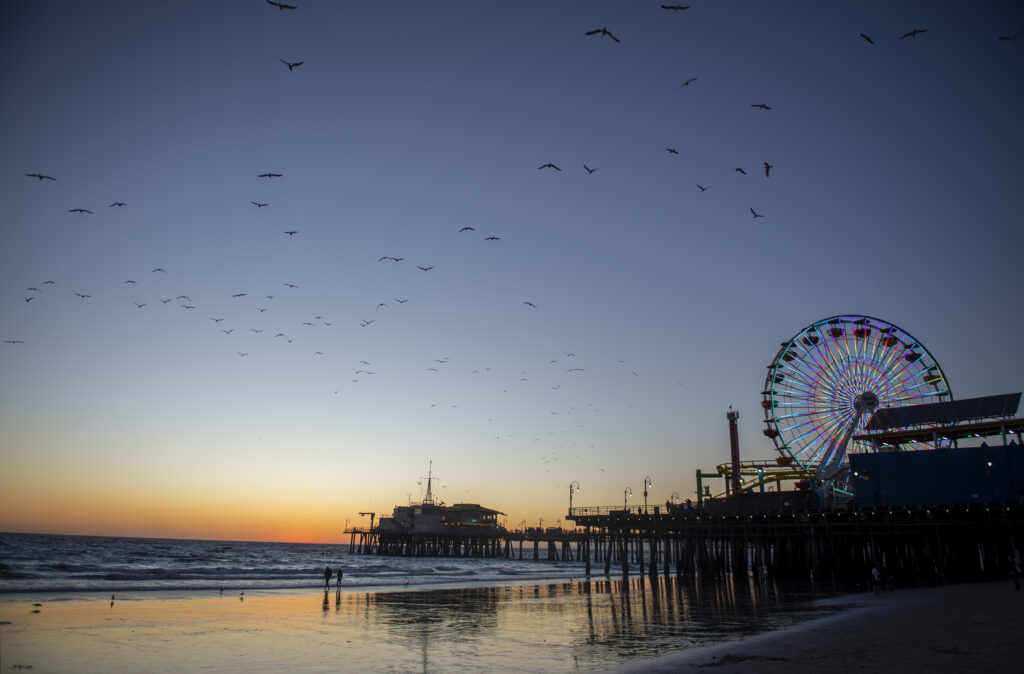
As Memorial Day Weekend Approaches, L.A. County Announces New Openings of Beach Bike Paths, Indoor Mall Curbside Service, and Permission for Car Parades
Los Angeles County has announced three new openings in advance of the holiday weekend, allowing increased outdoor and retail activities for residents. Beach bike paths are now open, indoor malls can open for curbside service, and car parades will be allowed.
Beach Bike Paths and Parking Lots
The opening of bike paths follows the May 13 announcement that County beaches would be available for active recreation. Allowable recreation activities now include swimming, surfing, running, walking, skating, and biking. Beach bathrooms remain open, and beach parking lots at Dockweiler State Beach, Will Rogers State Beach, Zuma Beach, and Surfrider Beach will be open at partial capacity. Santa Monica lots are closed, as are most public beach lots in coastal communities.
Safety protocols and additional information about beach visits include:
- #BYOM—Bring your own mask. Everyone needs a face covering while out of the water if there are other people nearby. Infants and children under the age of 2 should not wear cloth face coverings.
- Practice physical distancing. Stay at least six feet away from other people who are not in your household. Avoid crowded areas or crowding around others at the beach.
- Gatherings of any size or other events are not allowed on the beaches including athletic competitions, youth camps, or recreational programming.
- Chairs, umbrellas, canopies, coolers, and grills are not allowed.
- Piers, volleyball courts, and boardwalks are closed except for the purpose of customers accessing retailers curbside and doorside and essential businesses along the boardwalk.
- Concessions and food vending are not allowed. Bring what you may need with you.
More information on LA County beaches and parking lots can be found at beaches.lacounty.gov.
Indoor Shopping Malls
The County will also open indoor shopping malls for curbside service. Retail establishments and their customers must practice social distancing and wear face coverings, and the businesses must also be in compliance with the conditions laid out in this Checklist for Retail Establishments Opening for Curbside Pickup. It is recommended that shopping malls createclearly-marked curbside or outside pickup points that maintain physical distance with visual cues or other measures, and have purchased goods available there or available through home delivery. Retailers located within a mall may take orders and deliver goods to the public outside of the mall from these marked locations.
Car Parades
Car parades are now allowed so that graduations, birthdays and other special days and achievements can be safely celebrated. Car parades can not include participants on a bicycle, a motorcycle, a convertible with the top open, or a vehicle with no doors such as a golf cart. If any of the windows on a vehicle is open, the occupants of the vehicle must wear a face covering.
Any organization coordinating a large-scale parade must have a designated organizational host who is responsible for ensuring compliance with the rules for the parade and adherence to the State’s Stay At Home Order that precludes gatherings. Only those personnel of the organization necessary to facilitate the parade and to ensure compliance can be present at the location designated by the host.
The host must:
- At its own cost, arrange for and provide security sufficient to ensure compliance with the State’s Order and address any traffic and safety issues.
- Develop a parade plan that deals with State’s Order, traffic and safety issues, parade participants, and social distancing requirements.
- Ensure participants and personnel adhere to the face covering and physical distancing requirements.
- The host may provide a significant document to one vehicle parade participant at a time, such as a diploma or other paper, while adhering to face covering and social distancing requirements.
The parade must:
- Take place in an outside location large enough to accommodate the social distancing requirements.
- Proceed by the host’s invitation only, with the parade limit of vehicles tied to the capacity size of the location.
- Not allow sales or exchanges of any items or food. **For clarification, “exchanges” ARE allowable for students to receive their diploma (i.e. would need to align with APPENDIX D: Protocol for Vehicle-Based Parades, especially #11 and #12 which make it clear how students may receive their diplomas)**
COVID-19 briefing with LA County officials – May 21, 2020
https://covid19.lacounty.gov/wp-content/uploads/Briefing-for-May-21-2020.jpg
874
496
COUNTY OF LOS ANGELES
//covid19.lacounty.gov/wp-content/uploads/COVID19_Header_Logo.v2.png
COVID-19 briefing with LA County officials – May 21, 2020
COVID-19 briefing with LA County officials – May 21, 2020
COVID-19 briefing with LA County officials – May 20, 2020
https://covid19.lacounty.gov/wp-content/uploads/Briefing-for-May-20-2020.jpg
872
439
COUNTY OF LOS ANGELES
//covid19.lacounty.gov/wp-content/uploads/COVID19_Header_Logo.v2.png
COVID-19 briefing with LA County officials – May 20, 2020
COVID-19 briefing with LA County officials – May 20, 2020
L.A. County Economic Resiliency Task Force Sets Sight on July 4 Reopening
https://covid19.lacounty.gov/wp-content/uploads/updated-cover-logo-1024x512.png
1024
512
COUNTY OF LOS ANGELES
//covid19.lacounty.gov/wp-content/uploads/COVID19_Header_Logo.v2.png
L.A. County Economic Resiliency Task Force Sets Sight on July 4 Reopening
L.A. County Economic Resiliency Task Force Sets Sight on July 4 Reopening
L.A. County’s Economic Resiliency Task Force is developing fast-track plans for economic reopening and recovery by July 4, as industry work groupsㅡin diverse areas ranging from bioscience, hospitality and education to sports, entertainment and the artsㅡforge ahead with concrete proposals for resuming operations safely.
The proposed timetable was unveiled during the task force’s second meeting, which was held today and included a presentation by the Los Angeles Economic Development Corporation that underscored the high stakes and urgency of the local economic situation as the COVID-19 crisis continues.
Bill Allen, president of the LAEDC, said there have been more than 1 million unemployment claims filed in L.A. County to date. More than 75% of the projected job losses are in positions earning an average of $50,000 a year or less, with restaurants and retail industries hit the hardest.
Los Angeles County Supervisor Barger, the task force chair, said a safe reopening is needed as soon as possible. “I understand the urgency to reopen and know many of the experts the County has assembled for this task force have been working hard to develop safe and efficient plans to revitalize their sectors as early as next month,” Barger said. “I remain focused on working with industry leaders and health officials to safely make way for Los Angeles County to reopen by the Fourth of July.”
The hearing included presentations from 13 industry representatives, who described the impacts of COVID-19 on their sectors. Jerry Greenberg, representing the restaurants/leisure/hospitality sector, reported that 80% of restaurant jobs have been lost. Pat Niemann, representing corporate business, discussed the consequences of reopening delays and the dangers of long-lasting unemployment. Donna Langley, film and entertainment representative, reported that the industry’s 890,000 film and entertainment employees were for the most part not working and noted that this unemployment trickled down to small business vendors as well.
Though each sector reported specific impacts, some common critical needs emerged in the meeting, including rapid but safe reopenings and customized guidance and health/safety protocols for sectors. Several members expressed the desire for new public-private partnerships and revenue streams to create jobs.
Los Angeles County Supervisor Hilda L. Solis, the task force’s vice chair, thanked the task force members and recommended using the LAEDC report as a roadmap for the work ahead. “It should spur discussion and guide us on what we face here in the County in all segments of our society, whether it’s education, healthcare, entertainment, workforce development, or safety for our employees,” she said. “We can move through this cautiously and expeditiously.”
Supervisor Mark Ridley-Thomas said that strategies for reopening should pay special attention to underserved and disadvantaged communities, including communities of color. “We can construct a much brighter future for all of us in Los Angeles County,” he said, “if we focus on equity and prosperity.”
Supervisor Sheila Kuehl noted the critical importance of public cooperation as we move closer to re-opening. “Our ability to re-open depends on a very high level of cooperation from the public. If it weren’t for the public’s willingness to practice social distancing, wear face covers and take necessary precautions, we would not be in a position to begin to plan a re-opening, and our ability to meet our goal of reopening as fully as possible as quickly as possible is dependent on each and every resident of this county doing their part to protect their own health, the health of their family and their community,” Kuehl said.
Supervisor Janice Hahn said it’s essential to get small businesses up and running. “The longer we stay closed in certain sectors, particularly small businesses and restaurants, the odds are that they will not be able to come back,” she said. “I feel that we have to get to the point that we learn to live with the virus. We cannot stay locked down forever. My hope is that this task force will bring forth real plans for reopening these sectors that our Department of Public Health can agree on and present to the governor.”
The task force’s next meeting is scheduled for June 2.
Economic Resiliency Task Force Sector Representatives
- Arts and Culture: Tim Dang, USC
- Business - Corporate / Manufacturing: Pat Niemann, Ernst & Young
- Business - Small: Linda Griego, MLK Community Health Foundation and Griego Enterprises, Inc.
- Commodities / Goods Movement: Mario Cordero, Port of Long Beach
- Education: Dr. Barry Corey, Biola University
- Faith Organizations: Jackie DuPont-Walker, African Methodist Episcopal Church
- Film / Digital Media: Jeff Shell, NBCUniversal
- Foundations / Nonprofits: Regina Birdsell, Center for Nonprofit Management
- Healthcare / Bioscience: Dr. Hector Flores, Adventist Health White Memorial
- Infrastructure Development / Construction: Fran Inman, Majestic Realty
- Labor: Ron Herrera, LA County Federation of Labor
- Restaurants / Leisure / Hospitality: Jerry Greenberg, Sugarfish.
- Sports / Entertainment: Casey Wasserman, LA 2028
The Economic Resiliency Task Force was created by a board motion by Supervisors Barger and Solis, and unanimously adopted on April 28, 2020. A copy of that motion can be found here.
COVID-19 briefing with LA County officials – May 19, 2020
https://covid19.lacounty.gov/wp-content/uploads/Briefing-for-May-19-2020.jpg
874
491
COUNTY OF LOS ANGELES
//covid19.lacounty.gov/wp-content/uploads/COVID19_Header_Logo.v2.png
COVID-19 briefing with LA County officials – May 19, 2020
COVID-19 briefing with LA County officials – May 19, 2020
COVID-19 briefing with LA County officials – May 18, 2020
https://covid19.lacounty.gov/wp-content/uploads/Briefing-May-18-2020.jpg
876
494
COUNTY OF LOS ANGELES
//covid19.lacounty.gov/wp-content/uploads/COVID19_Header_Logo.v2.png